

in-space propulsion: why electric?
hall effect propulsion & a high level view of the underlying physics

what is in-space electric propulsion?
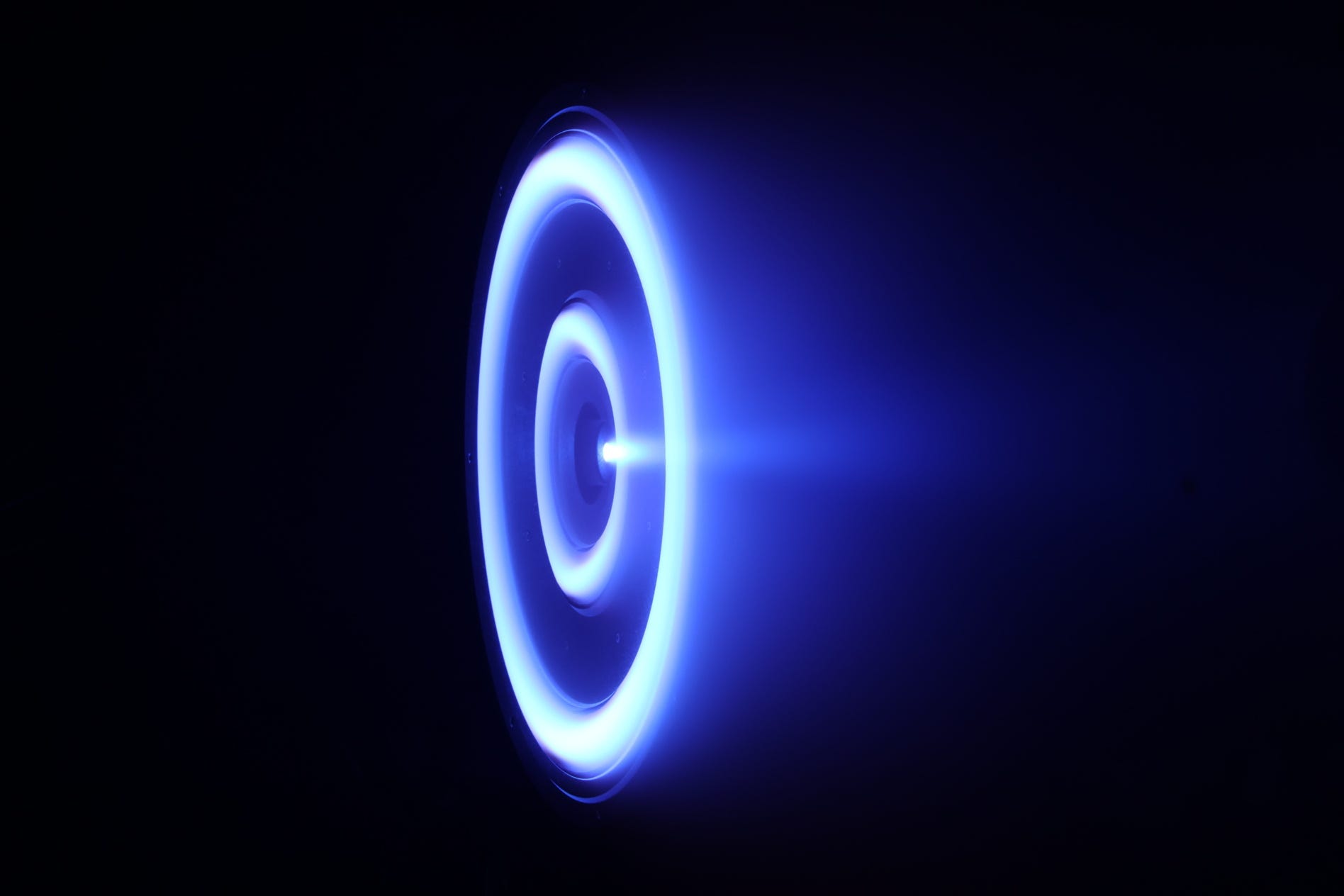
Electric propulsion systems use electrostatic or electromagnetic fields to accelerate a propellant to high speeds, producing thrust to modify a spacecraft's velocity in orbit. That’s it…..but wait, there’s more!
They have some great advantages:
Higher efficiency: Electric thrusters use much less propellant than chemical rockets due to their higher exhaust speeds (higher specific impulse).
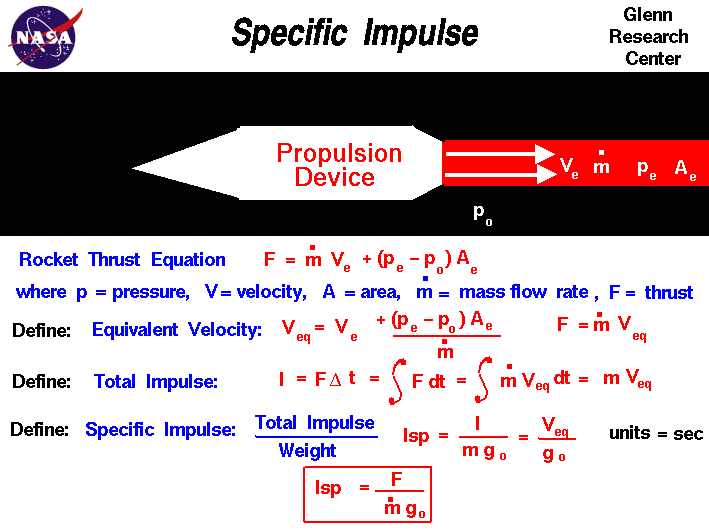
Long duration: While the thrust is weaker than chemical rockets, electric propulsion can provide thrust for much longer periods.
High total impulse: Electric propulsion can impart large velocity changes over time, making it suitable for long-duration missions
And there’s a variety of these guys.
types of electric propulsion
ion and plasma drives
These use electric energy to accelerate ions or plasma to generate thrust. Common types include:
Hall-effect thrusters
Gridded ion engines
Multi-stage plasma thrusters
other types
Electrodynamic tethers
Photonic drives (interacting only with photons)
Today, we will be looking at the hall effect thrusters:
hall effect thrusters
definition:
A Hall effect thruster is an electric propulsion device that uses a combination of electric and magnetic fields to ionize and accelerate propellant (typically xenon), generating thrust for spacecraft with high efficiency and reliability.
core mechanics
Hall thrusters work by injecting propellant into an annular discharge chamber containing an anode and a cathode, with a radial magnetic field imposed between the two. Electrons injected by the cathode spiral in the magnetic field, ionizing the neutral gas. The resulting ions are then accelerated axially by the electric field, producing thrust as they exit the thruster1
Higher power allows the thruster to ionize more propellant and accelerate it to higher velocities, increasing thrust and specific impulse, but also requires efficient power management to maximize propulsion efficiency without excessive energy loss.
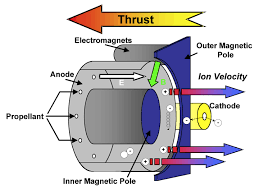
The main physical principles at play are the Lorentz force and the Hall effect. The Lorentz force equation governing ion acceleration is:
where:
q is the particle charge,
E is the electric field vector,
v is the particle velocity vector,
B is the magnetic field vector.
In a Hall thruster, ions (which are much heavier than electrons) are not significantly affected by the magnetic field and are accelerated primarily by the electric field. In contrast, electrons are magnetically confined and circulate azimuthally (forming the Hall current).
The thrust produced, T, as a function of beam current I_i, discharge voltage V_d, ion mass M, and elementary charge e is:
The Hall parameter (β) measures how strongly electrons are magnetically confined and is defined as:
where:
ω_ce is the electron cyclotron frequency,
ν_e is the electron collision rate.
For efficient electron confinement in the thruster, β should be much greater than one (β >> 1).
propellant
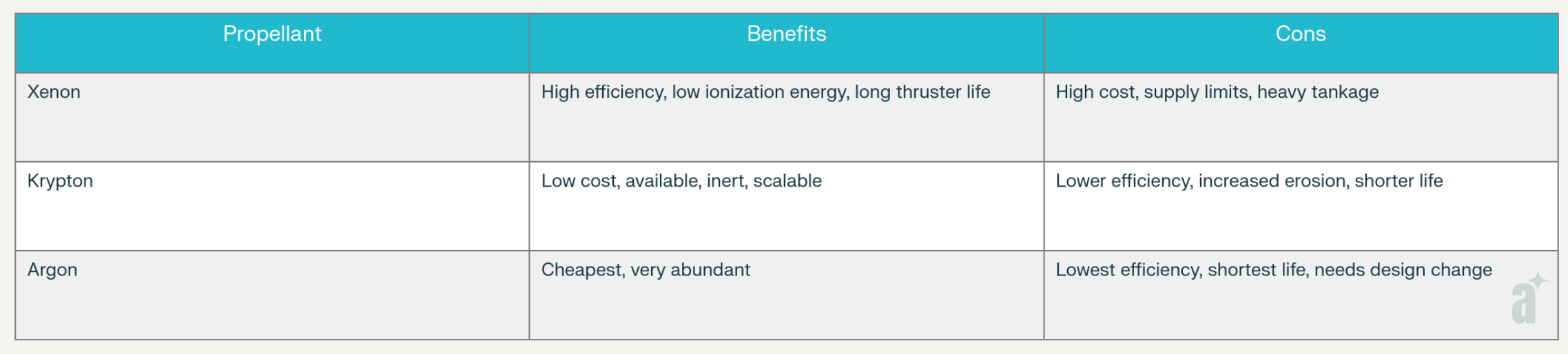
Propellants for Hall effect thrusters are chosen based on factors like atomic mass, ionization energy, chemical inertness, storage ease, erosion effects, cost, and mission needs to balance performance, durability, and economy. Xenon is preferred for its efficiency and longevity, while krypton and argon offer lower cost but require thruster modifications and have trade-offs in efficiency and lifespan2
applications
Hall effect thrusters are widely used for:
Orbit raising and station-keeping for satellites in low and geosynchronous Earth orbit.
Main propulsion for interplanetary robotic and satellite missions.
Hall thrusters offer a combination of moderate/high specific impulse (typically 1,500–2,500 s) and efficiency (up to 75% in advanced designs), making them key for long-duration, mass-efficient space missions!
The electric mobility movement is not limited to EVs and space is seeing new forms of these electric propulsion engines entering the sector. Companies like Benchmark Space3 are working on novel metal propellant thrusters with high impulses in small packages.
Exciting times to get moving in space ;)
https://htx.pppl.gov/thrusters.html
https://cheops-vhp-bb.eu/2024/09/19/hall-thruster-propellants-finding-the-best-fit/
https://www.benchmarkspacesystems.com/products/electric-propulsion